
 EN

How Air Compressor PMSM Meets Variable-Air-Volume Requirements in Multi-Unit Factory Production-Line Systems
In a multi-unit factory, compressed-air demand rarely stays flat. Packaging machines cycle, assembly fixtures start and stop, purge stations open at different times, and a single shift change can alter the load profile within minutes. An Air Compressor PMSM can help a plant follow that changing demand when it is paired with a correctly sized compressor element, variable-frequency drive (VFD), air receiver capacity, and coordinated control logic. The important point is not simply to install a faster motor; it is to make the whole compressed-air system respond predictably.
From a technical-sales viewpoint, the first question is not “What motor rating do you need?” It is “What air flow and pressure stability does each production state require?” An Air Compressor PMSM is most useful when it is specified from measured operating points rather than a single peak-flow estimate.
Why multi-unit lines create a difficult air-demand profile
Several production units connected to one header create both slow demand changes and fast disturbances. A line may need a stable header pressure for actuators, but its total air volume can move from a low base load to a short peak when multiple stations index together. Fixed-speed compressors commonly respond through load/unload cycles, inlet modulation, or blow-off control. Those methods may maintain pressure, but they can waste input power during long partial-load periods.
An Air Compressor PMSM driven by a VFD can vary compressor speed so delivered flow follows the trim portion of demand. More precisely, it can do so within the compressor’s approved speed range and within the thermal, electrical, and surge or minimum-flow limits of the complete machine. Treating a motor’s nameplate power as a fixed field result is fine for rough planning; once ambient temperature, ventilation, and duty cycle are considered, the usable continuous operating range can shift considerably.
Start with a demand map, not a motor nameplate
Before selecting an Air Compressor PMSM, capture at least one representative production week. Log header pressure, total flow, compressor kW, machine state, shift, and major batch changes at a common time interval. Then identify four values: minimum stable demand, normal running demand, recurring short peak demand, and the longest low-demand period. Also note whether pressure dips occur because supply is short, storage is insufficient, a regulator is poorly placed, or a downstream event consumes air too quickly.
That map separates a base-load compressor from a trim compressor. In many multi-unit layouts, the most practical configuration is one or more efficient fixed-capacity base machines plus one Air Compressor PMSM as the trim machine. The trim machine absorbs routine variation while the base machines operate near their efficient range. This is generally easier to control than asking every compressor to chase the same pressure signal independently.
Match flow control with pressure control
Variable air volume does not mean that every pressure fluctuation should command an immediate speed change. Set a realistic header-pressure band, then use VFD ramp limits, deadband, and receiver storage to prevent hunting. An Air Compressor PMSM should receive a speed reference that reflects a filtered system demand signal, not electrical noise or a transient at one actuator bank.
You might be thinking that a very narrow pressure band necessarily gives stronger production protection. The problem is that an overly aggressive loop can make the Air Compressor PMSM repeatedly accelerate and decelerate, increasing heat and reducing control stability. A slightly wider but validated pressure band, adequate receiver volume, and point-of-use regulation often protect process equipment more effectively.
Use the air receiver as a control component
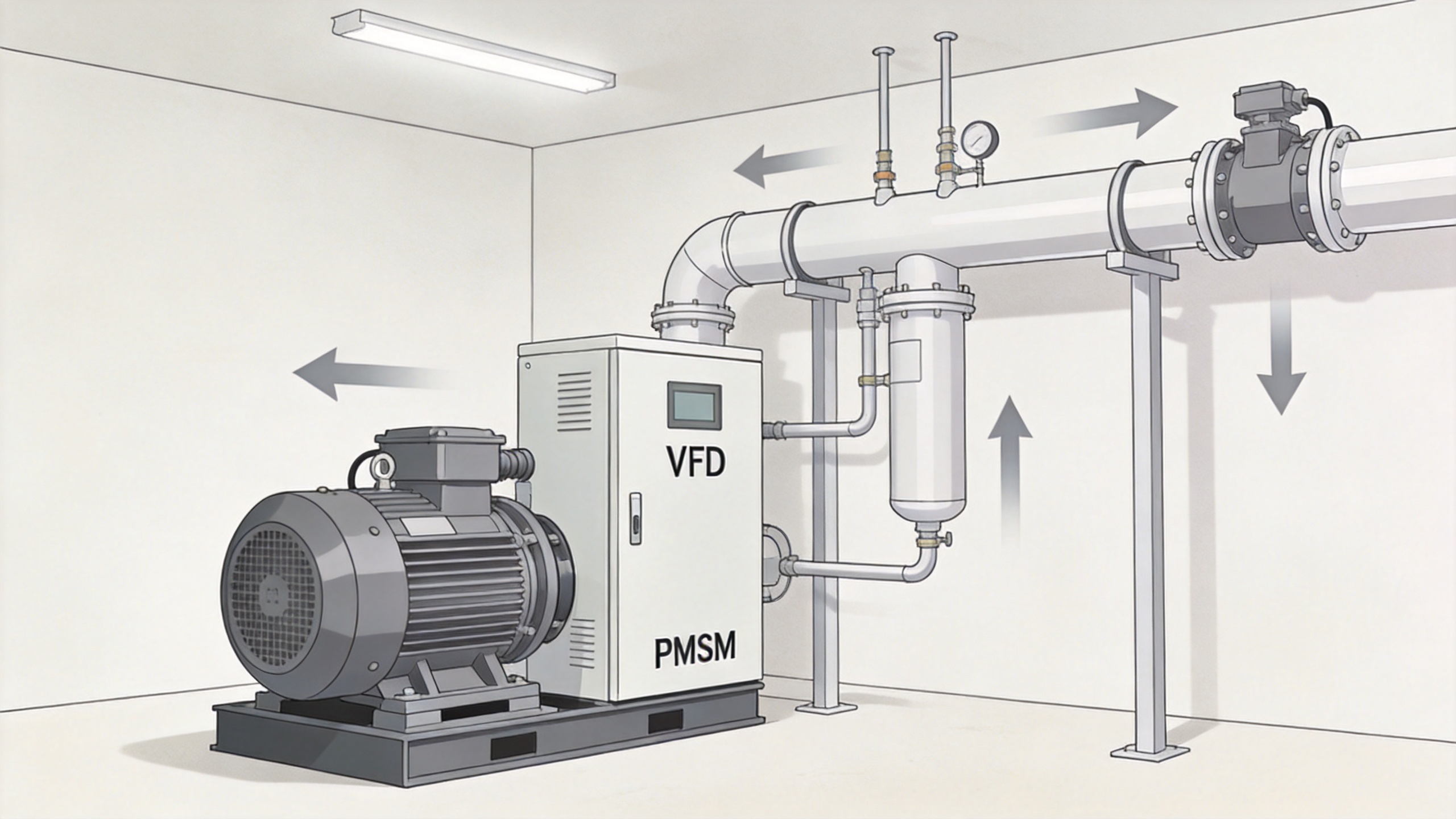
Receiver capacity is not merely a tank-size line item. It provides short-term stored air while the Air Compressor PMSM changes speed, and it reduces the chance that simultaneous cylinder movements produce a header-pressure dip. Put sensors where they reflect the pressure that critical users actually see, and check pressure drop across dryers, filters, pipe branches, and isolation valves. A controller cannot compensate cleanly for a badly restricted distribution path.
Coordinate multiple compressors instead of creating control conflicts
For a multi-unit system, assign clear roles. Base machines should start and stop according to sustained demand thresholds. The Air Compressor PMSM should normally trim within a defined speed window. A master controller, or a properly configured plant controller, should decide which machine has priority, enforce minimum run and off times, rotate lead duty if appropriate, and prevent more than one compressor from trying to trim the same small load change.
Research on industrial compressed-air optimization has reported substantial improvement in a studied system when master control sequenced compressors to avoid excessive unload time. That does not guarantee the same result at every factory, but it supports a practical rule: evaluate the sequence, not just the efficiency rating of an individual Air Compressor PMSM.
Specify the motor and drive for real factory conditions
A Permanent Magnet Motor PMSM can offer strong efficiency and controllability in variable-speed duty, but its integration still needs engineering checks. Confirm the VFD and motor insulation system are compatible, the cable and grounding arrangement follows the drive supplier’s requirements, the enclosure and cooling method suit the compressor room, and the protective functions cover overload, overtemperature, phase loss, earth fault, and communication loss.
For the Air Compressor PMSM, review the allowable speed range, constant-torque and constant-power regions, bearing arrangement, cooling at low speed, and restart behavior after a voltage interruption. Do not assume a compact motor removes the need for heat management. In a hot compressor room, inlet-air temperature and cabinet ventilation can affect both compressor efficiency and drive derating.
Commission against operating states, not just a no-load test
Commission an Air Compressor PMSM during the actual states it must serve: warm-up, normal production, synchronized high-demand events, breaks, line restart, and a base-compressor handoff. Record flow, pressure, kW, speed, temperature, and alarm history. Test what happens when a sensor fails or a communications link is lost; the fallback mode must protect production rather than leave the machine oscillating.
This is where lifecycle cost becomes clearer. The purchase price matters, but downtime, unstable pressure, nuisance trips, and wasted unloaded running can cost more over the system’s service life. ISO 50001-style energy management offers a useful discipline here: establish a baseline, measure performance, act on the findings, and verify the result after each control change.
A practical selection checklist
- Measure base, normal, peak, and transient compressed-air demand before sizing the Air Compressor PMSM.
- Define whether the machine is a trim compressor, a base compressor, or a standby unit.
- Validate the VFD speed range, cooling, protection, cable design, and compressor limits.
- Set pressure bands, ramp rates, and receiver capacity together instead of tuning them in isolation.
- Use coordinated sequencing so the Air Compressor PMSM does not compete with other compressors.
- Commission at real production states and compare kW and pressure stability to the measured baseline.
Conclusion
An Air Compressor PMSM is most likely to meet variable-air-volume requirements when it is part of a measured, coordinated system. The motor and VFD provide controllable speed; the receiver, header, sensors, and master logic turn that capability into stable air delivery. For a multi-unit production line, that approach can improve process resilience and create a sound basis for energy optimization without making unsupported site-specific savings promises.

