
 EN

Direct Drive Motor Solutions for Industrial Noise and Vibration
Continuous processing facilities operating large induced-draft cooling towers and heavy aeration fans 8,400 hours annually often struggle with intense acoustic noise and destructive structural vibration. Maintenance supervisors inspecting mechanical bays frequently discover that standard high-speed induction motors linked to multi-stage gearboxes generate persistent mechanical resonance across fan decks and structural frames. Upgrading heavy industrial machinery to a low-speed direct drive motor removes intermediate gearboxes, stabilizes dynamic load balance, and slashes ambient sound pressure levels across continuous manufacturing facilities.
Conventional mechanical drivetrains utilizing gearboxes, jackshafts, and belt pulleys introduce multiple points of friction, tooth backlash, and dynamic imbalance. These mechanical vibrations transfer directly into surrounding support foundations, accelerating bearing fatigue, compromising structural welds, and generating workplace noise levels that violate occupational health limits. ENNENG develops advanced permanent magnet electric machinery engineered to eliminate intermediate mechanical reducers, delivering whisper-quiet operation, minimal dynamic vibration, and exceptional electrical efficiency across demanding industrial environments.
Mechanical Sources of Drivetrain Vibration and Noise
Large industrial mechanical equipment such as wet cooling towers, mine ventilation fans, and heavy slurry agitators requires low rotational velocities paired with high output torque. In conventional installations, achieving speeds between 100 RPM and 300 RPM requires coupling a standard 1,500 RPM induction motor to a mechanical speed reducer. This multi-element configuration introduces severe dynamic and acoustic complications that compromise plant operations.
High-Frequency Gear Mesh and Structural Resonances
The primary source of acoustic disturbance in geared drivetrains is high-frequency gear mesh. As gear teeth engage and disengage under heavy mechanical loading, cyclic deflection creates periodic impact forces that transmit through gearbox housings. These engagement impacts produce characteristic gear mesh excitation frequencies between 100 Hz and 1,000 Hz, radiating acoustic energy into adjacent process areas.
When these forced excitation frequencies coincide with the natural structural frequencies of steel skids, fan shrouds, or concrete plinths, acoustic amplification occurs. The resulting structural resonance magnifies physical vibration amplitudes well beyond baseline levels, creating severe mechanical stress across structural anchor bolts. Adopting a gearless motor system removes the mechanical gear set entirely, eliminating the high-frequency excitation forces that drive structural resonance.
Backlash Shock and Lubrication Breakdown Dynamics
Mechanical speed reducers depend on precise clearance between mating gear teeth to accommodate thermal expansion and lubricant film formation. Over thousands of operating hours, tooth wear expands this backlash clearance. Under fluctuating aerodynamic loads, tooth faces experience repeated impact reversals, generating sharp acoustic clicks and torsional shock waves throughout the drivetrain.
Furthermore, splash or pressure lubrication systems generate hydraulic churning noise as gear teeth pass through oil baths. In demanding operating conditions, lubricating oil suffers thermal oxidation, particulate contamination, and viscosity breakdown, increasing friction and metal-to-metal contact. Transitioning to a direct drive motor replaces intermediate gear contacts with a single electromagnetic air gap, permanently eliminating oil-churning noise, backlash shock, and lubrication maintenance liabilities.
Electromechanical Principles of Direct Drive Noise Attenuation
A direct drive motor transforms the mechanical drivetrain by coupling the driven load directly to the motor shaft at the exact operational velocity required by the driven machine. Integrating a low-speed PM synchronous motor enables facilities to eliminate mechanical reduction stages while enhancing dynamic torque control.
Eliminating Mechanical Reducers via Gearless Motor Architecture
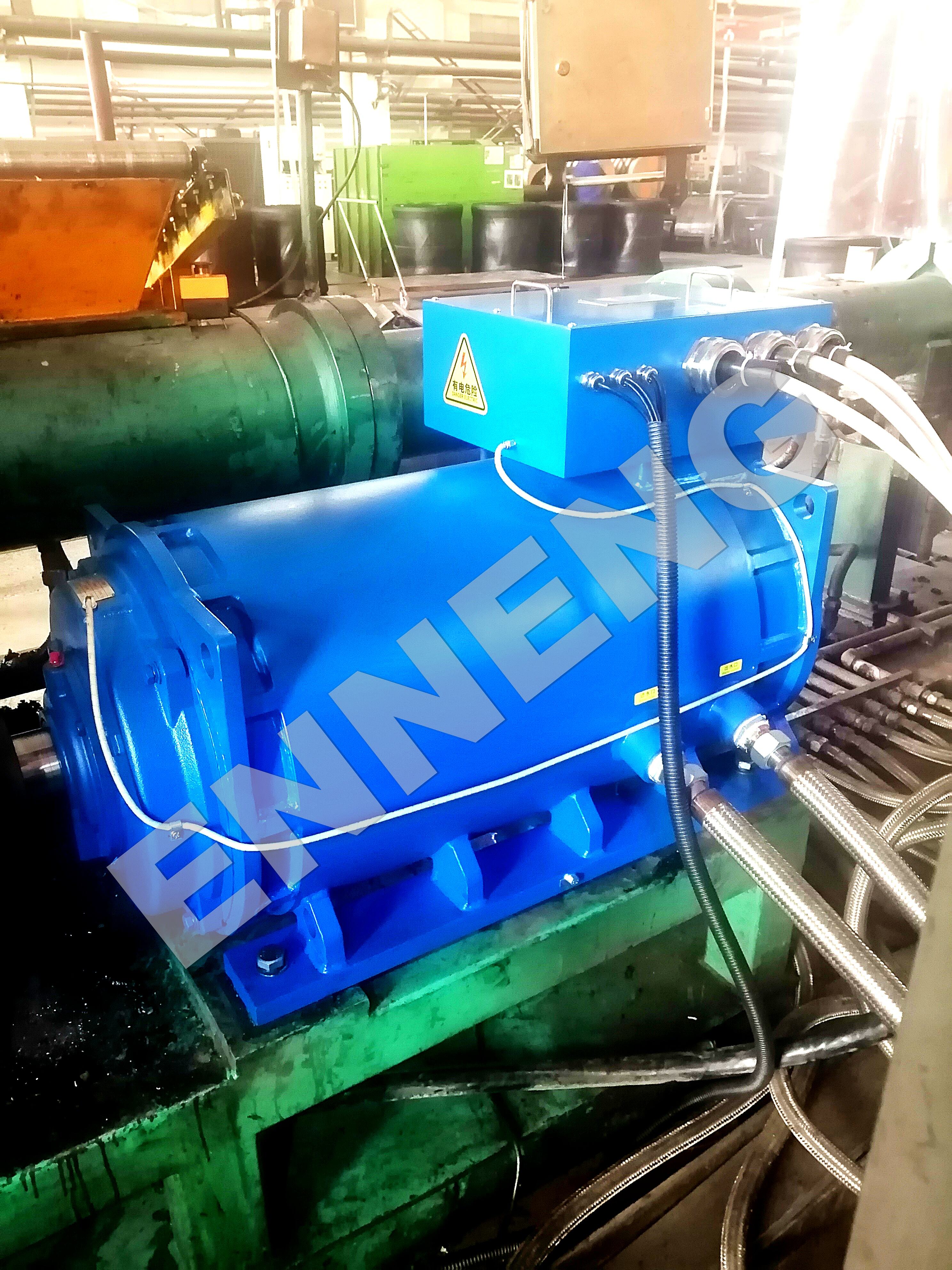
Eliminating intermediate mechanical components simplifies rotating dynamics. A conventional geared drive utilizes four or more bearing sets, high-speed couplings, intermediate shafts, and internal gear teeth, with each component introducing potential mechanical runout and dynamic imbalance. In contrast, an integrated gearless motor architecture reduces the entire drivetrain assembly to two primary motor bearings and a single rotating shaft.
Fewer mechanical interfaces directly reduce structural vibration transmission pathways. Because a low-speed direct drive motor operates at the exact rotational speed of the driven equipment, rotating components experience significantly lower centrifugal forces. Reducing mechanical complexity diminishes parasitic mechanical friction, allowing a direct drive motor to deliver smooth, quiet rotational torque across continuous industrial production cycles.
|
Mechanical Performance Parameter |
Conventional Geared Induction Drive |
ENNENG Direct Drive Motor |
|
Acoustic Noise at Fan Deck Level |
85 dB(A) to 95 dB(A) (high-frequency whine) |
70 dB(A) to 78 dB(A) (broadband low hum) |
|
Dominant Vibration Frequency Sources |
Gear mesh harmonics (100 Hz - 1,000 Hz) |
Low fundamental rotational frequencies |
|
Intermediate Drivetrain Elements |
Gearbox, drive shaft, flexible couplings |
Single direct shaft or hollow-shaft coupling |
|
Unified Operating Voltage Scope |
Standard 380V to 480V limits |
Unified 110V to 690V industrial range |
|
Unified Drive Power Capacity |
Fixed catalog ratings |
Unified 5kW to 5MW industrial capacity |
|
Mechanical Transmission Losses |
3% to 8% parasitic friction dissipation |
Zero mechanical reducer transmission losses |
|
Lubrication Maintenance Scope |
Routine oil changes, seal replacements |
Sealed grease bearings (no oil reservoir) |
Low-Speed Torque Density in Permanent Magnet Synchronous Systems
Delivering high output torque at low rotational speeds without intermediate gearing requires exceptional electromagnetic power density. A standard squirrel-cage induction machine cannot maintain sufficient torque density at low speeds without excessive frame sizing and heavy magnetizing current draw. A PM synchronous motor solves this constraint by embedding high-energy rare-earth neodymium-iron-boron magnets within the rotor assembly.
Permanent rotor magnets establish intense magnetic air-gap flux without consuming reactive current from the electrical supply. Modern vector-controlled inverters dynamically maintain stator current vectors in precise quadrature with rotor magnetic poles, allowing a direct drive motor to deliver full rated torque from standstill through base operational speeds. Furthermore, engineered stator slot skewing and optimized magnet geometries suppress electromagnetic cogging torque below 0.5%, preventing rotational torque ripple from exciting drivetrain vibration.
Acoustic Attenuation in Cooling Tower Direct Drive Operations
Cooling towers represent one of the most critical applications for acoustic and vibration mitigation. Conventional cooling tower drive packages position a high-speed motor outside the wet air stream, linked via a long composite drive shaft to an internal right-angle gearbox situated directly beneath the fan blades. The enclosed fan stack acts as an acoustic megaphone, amplifying gear mesh whine across surrounding industrial and municipal boundaries.
Implementing a cooling tower direct drive mounts a low-speed PM synchronous motor directly beneath the fan hub, eliminating drive shafts, intermediate pillow blocks, and right-angle gearboxes. This arrangement eliminates gear mesh frequencies, achieving measurable acoustic noise reductions between 5 dB(A) and 10 dB(A) across fan decks. A cooling tower direct drive eliminates gearbox oil leaks into circulating process water, delivering an environmentally clean energy saving motor solution that simplifies cooling infrastructure.
Advanced industrial machinery manufactured at ENNENG motor products covers unified voltage ratings from 110V to 690V and power capacities from 5kW to 5MW. For decentralized plant monitoring stations and off-grid remote power generation, ENNENG also supplies vertical axis wind turbine systems rated from 1kW to 10kW, emphasizing 3kW, 5kW, and 10kW platforms to ensure reliable utility generation.
Engineering Consultation and System Integration
Upgrading high-vibration machinery with an advanced direct drive motor lowers plant acoustic noise, eliminates gearbox maintenance costs, and maximizes continuous operational reliability. Collaborating with an established high efficiency motor supplier guarantees proper low-speed torque sizing, verified torsional vibration modeling, and complete electrical drive package integration. Technical specialists perform detailed structural resonance analyses, acoustic surveys, and custom mechanical flange adaptations to modernize challenging industrial drivetrains. Inquire today to evaluate industrial equipment parameters and specify customized direct drive solutions.
- WhatsApp: +86 18562780228
- E-Mail: [email protected]
- Phone: +86 532 66000559
FAQ
Q: How does a direct drive motor reduce mechanical vibration compared to a geared system?
A: A direct drive motor couples directly to the driven shaft at operating speed, completely eliminating intermediate gearboxes, high-speed couplings, and jackshafts. Removing gear tooth mesh eliminates the high-frequency harmonic impact forces (100 Hz to 1,000 Hz) that excite structural resonances in machinery frames. Operating with fewer rotating components and lower shaft speeds keeps overall vibration velocity well below ISO 10816-3 Class A thresholds.
Q: What acoustic noise reductions are achievable by installing a cooling tower direct drive?
A: Replacing a conventional motor and right-angle gearbox with a cooling tower direct drive typically lowers acoustic noise levels by 5 dB(A) to 10 dB(A) at fan deck level. Eliminating gear tooth engagement removes high-frequency mechanical whine, leaving only broad aerodynamic airflow noise. This substantial acoustic attenuation assists industrial facilities in complying with OSHA occupational workplace noise regulations and municipal boundary sound limits.
Q: Why is a PM synchronous motor uniquely qualified for low-speed direct drive operations?
A: A low-speed PM synchronous motor utilizes high-coercivity rare-earth permanent magnets to establish intense air-gap flux without drawing reactive magnetizing current. This electromechanical architecture delivers superior torque density within a compact frame, enabling the motor to produce full rated torque at rotational speeds between 50 RPM and 300 RPM. Furthermore, precision stator skewing reduces cogging torque below 0.5%, ensuring smooth rotation without torsional pulsation.

