
 EN

An Energy Saving Motor Solution should not begin with a catalog efficiency number. It should begin with what a workshop actually asks its motors to do: how many hours they run, where their load sits, how speed changes, and what production output looks like during each shift. That is how an Energy Saving Motor Solution turns a promising percentage into a savings estimate a plant team can test.
The common shortcut is to multiply motor nameplate kW by an assumed improvement and annual hours. It is quick, but it can be wrong in either direction. A realistic Energy Saving Motor Solution uses measured input power, duty-cycle segments, efficiency at the working point, and the site’s electricity tariff. It then keeps motor-only savings separate from savings created by process or speed control.
Start with the workshop, not the motor label
A technical sales review for an Energy Saving Motor Solution starts by grouping motors by service. Pumps, fans, compressors, conveyors, mixers, machine tools, and test stands do not share the same load pattern. Two 22 kW motors may have very different annual energy use if one operates near a steady load for three shifts and the other cycles lightly for a single shift.
For each candidate, the Energy Saving Motor Solution records rated power, voltage, control method, operating hours, current or kW readings, speed, load changes, starts, ambient conditions, maintenance history, and the process result that matters. Useful baseline meters capture real kWh over a representative period; short spot measurements are useful screening evidence, not final proof.
Part-load matters. Motor performance is not flat from zero to full load, and a nameplate efficiency value is normally a full-load reference. Guidance on motor loading notes that efficiency often peaks near roughly three-quarters load, while the useful range depends on the motor size and design. That is why an Energy Saving Motor Solution should use manufacturer curves or test data at the actual operating point whenever they are available.
The calculation model behind a realistic estimate
For every duty segment, an Energy Saving Motor Solution estimates baseline input power and retrofit input power, then multiplies their difference by the hours in that segment:
Annual kWh saved = Σ[(Baseline input kW − Retrofit input kW) × annual hours at that condition]
Annual cost savings are annual kWh saved multiplied by the applicable energy tariff. If demand charges, time-of-use rates, or compressed-air and cooling interactions matter, the Energy Saving Motor Solution documents them as separate assumptions rather than hiding them inside an efficiency percentage.
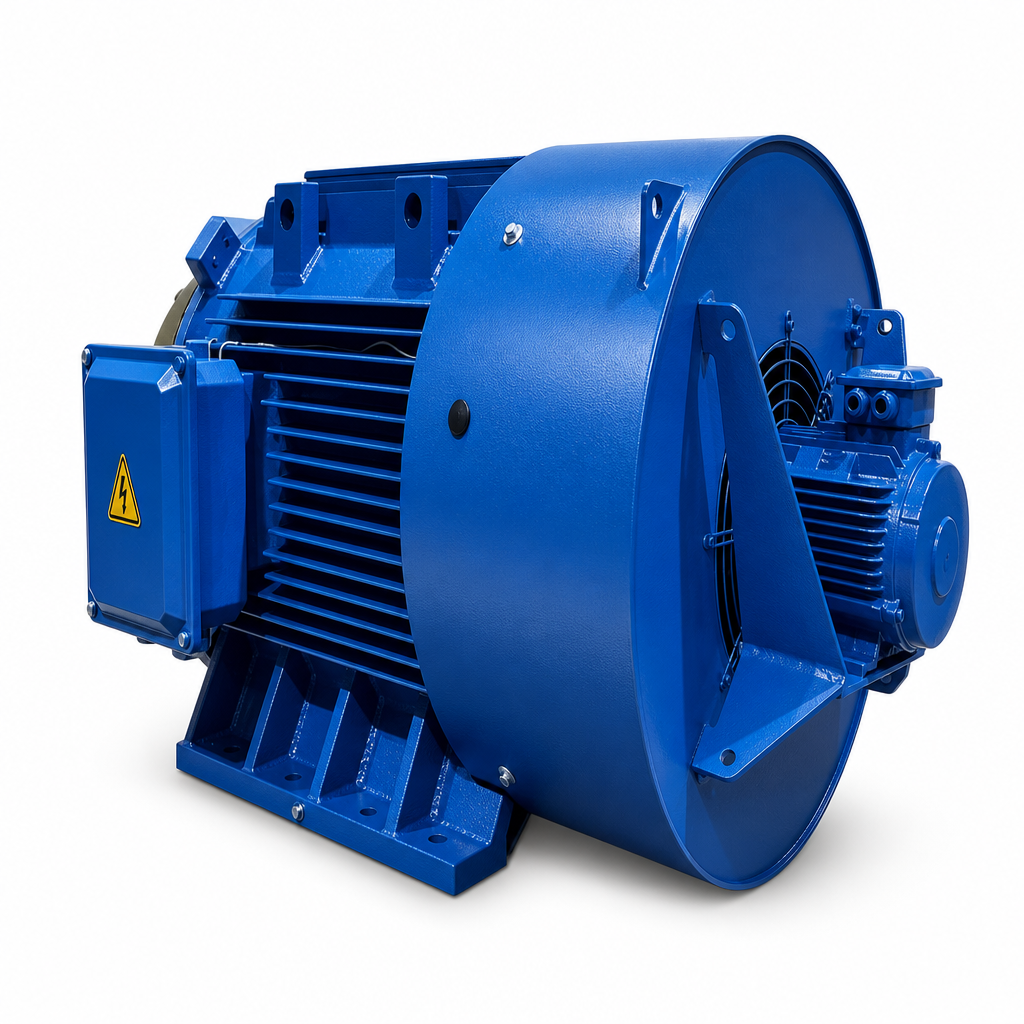
For a direct Retrofit Induction to PMSM, the comparison normally includes the existing induction motor’s measured or defensible part-load efficiency, the permanent-magnet motor’s efficiency at the same shaft demand, and any controller loss. An Energy Saving Motor Solution must also confirm that the driven load and required speed remain comparable before and after the retrofit. Otherwise, the result is a process change calculation, not a like-for-like motor calculation.
Why different workshops produce different results
Steady-load production lines
Extrusion, conveying, rolling, and some machine-tool auxiliaries can run for long hours at a fairly stable demand. Here, an Energy Saving Motor Solution often has the cleanest baseline because production-normalized kWh and operating hours are easier to compare. The energy benefit may be meaningful even when the percentage efficiency change is modest, simply because the motor runs so long. But teams should still check load level, downtime, and product mix rather than annualizing a single day.
Variable-torque pump and fan workshops
Ventilation, cooling-water, dust collection, and circulation systems need a different Energy Saving Motor Solution. If flow is controlled by throttling or dampers, speed reduction may dominate the opportunity. For centrifugal pumps and fans without static-lift constraints, power follows approximately the cube of speed ratio. A 20% speed reduction can therefore imply roughly a 50% reduction in input power under those stated conditions. That is not a universal motor claim; it is a system-law result that must be checked against the actual pump curve, static head, process demand, and control arrangement.
Intermittent, high-start, or lightly loaded workshops
Press shops, packaging cells, and maintenance areas may have long idle periods, rapid cycles, or oversized motors. An Energy Saving Motor Solution should divide the day into run, idle, and peak segments instead of applying one average load factor. In these settings, correcting oversizing, reducing idle operation, or revising control logic can matter as much as the motor replacement. A Retrofit Induction to PMSM may still fit, but its projected benefit should be tied to the verified duty cycle.
Use ranges and sensitivity checks, not one optimistic number
A credible Energy Saving Motor Solution gives a conservative, expected, and favorable scenario. Vary the annual hours, baseline load, motor efficiency inputs, and tariff within documented bounds. If the payback only works in the favorable case, the project should be presented as conditional. This is a more useful decision tool than a single headline saving figure.
It is true that permanent-magnet equipment can have a higher upfront cost. The relevant question, though, is not only purchase price; it is the lifecycle effect of energy, maintenance access, downtime exposure, controls, and commissioning. An Energy Saving Motor Solution should show those items separately, especially when a new drive, cabling change, harmonics assessment, or protection review is required.
Verify the result after commissioning
Before installation, the Energy Saving Motor Solution defines a measurement and verification plan: meters, interval length, production denominator, weather or process variables, and acceptance criteria. After commissioning, compare matched operating conditions and normalize results to units produced, flow delivered, or operating hours. The short answer is that an Energy Saving Motor Solution is most trustworthy when predicted and measured kWh can be reconciled.
That discipline also improves the next project. A workshop can build a ranked motor inventory from measured annual kWh, technical suitability, and confidence in the baseline. The result is not a generic savings promise. It is an Energy Saving Motor Solution that shows which motors deserve action first, what evidence supports the estimate, and which assumptions still need validation.
A practical request list for a defensible proposal
- At least a representative interval of kW, current, speed, and operating-hour data.
- Motor nameplate details, existing control method, and driven-equipment information.
- Duty-cycle segments and the production or flow measure used for normalization.
- Electricity tariff details, including demand or time-of-use terms where applicable.
- Retrofit constraints: enclosure, mounting, shaft coupling, power quality, protection, and commissioning access.
With these inputs, an Energy Saving Motor Solution can state what is measured, what is modeled, and what must be proven on site. That distinction is what makes energy-saving benefits realistic across different industrial workshops.
If you are evaluating commercial permanent magnet motors for sale and need an engineered drive solution that guarantees efficiency and longevity, ENNENG is your trusted partner.Contact ENNENG Today.Speak to our technical engineering team to receive a customised drive proposal.
- WhatsApp: +86 18562780228
- E-Mail: [email protected]
- Phone: +86 532 66000559

