
 EN

What Main Factors Determine the Practical Energy-Saving Rate of Permanent Magnet Motor PMSM in Industrial Applications?
A Permanent Magnet Motor PMSM can be a strong efficiency choice, but its practical energy-saving rate is not a single number printed on a nameplate. In industrial service, the result depends on the load profile, the speed-control method, the driven machine, and the quality of installation. As a renewable-energy engineer reviewing motor-drive projects, I start with the operating hours and torque curve rather than a peak-efficiency claim.
The useful question is not, “Is a PMSM efficient?” It is, “How much electrical energy will this specific Permanent Magnet Motor PMSM system avoid over its real duty cycle compared with the existing arrangement?” That distinction matters when a line runs at reduced flow, cycles between loads, or relies on a variable-frequency drive (VFD).
Start with the whole motor-driven system
Practical savings come from the product of several efficiencies: the VFD, the motor, the transmission, and the driven equipment. A highly efficient Permanent Magnet Motor PMSM does not erase losses in a poorly selected pump, belt drive, gearbox, fan, or control loop. Likewise, an attractive motor-only comparison can overstate the annual result if the old system already operates close to a favorable operating point.
For a fair estimate, use measured or credible estimates for input kWh before and after the change across each normal operating mode. Include production time, idle time, starts, process constraints, and auxiliary loads. This shifts the evaluation from catalog efficiency to energy per unit of useful output.
1. The duty cycle and load profile usually matter most
Peak efficiency at rated load is useful, but many industrial assets spend much of the year away from rated load. Pumps, fans, compressors, conveyors, mixers, and machine tools all have different torque behavior. A PM Synchronous Motor may retain an advantage in a variable-duty application, particularly when the replacement motor has materially weaker part-load behavior; however, the actual gain must be read from efficiency maps at the expected speed and torque points.
This is the shift from chasing peak efficiency to matching the duty cycle. If a motor is oversized and normally runs lightly loaded, reducing nameplate losses may help, but correcting the size and control strategy can matter even more. Conversely, a continuously loaded machine near rated output may realize a more modest saving than a variable-load system, even when both use the same motor technology.
2. Speed control can create the largest process-level saving
When a process currently uses throttling, dampers, bypasses, or repeated start-stop control, pairing a Permanent Magnet Motor PMSM with a correctly configured VFD can change the energy equation. For centrifugal pumps and fans, the U.S. Department of Energy notes that reducing speed by 20% can reduce input-power requirements by approximately 50%. That is a conditional pump-and-fan illustration, not a universal PMSM saving rate.
The reason is the driven load, not motor magnet material alone. A fixed-torque conveyor or extruder responds differently: power tends to track speed more nearly linearly. The comparison therefore needs a torque-versus-speed profile before anyone promises a percentage reduction.
3. Motor, VFD, and control compatibility set the usable efficiency
A Permanent Magnet Motor PMSM requires suitable control parameters, feedback strategy where applicable, switching settings, and protection limits. VFD losses rise and fall with drive size, loading, carrier frequency, and operating point. Cable length, harmonic conditions, voltage imbalance, and poor grounding can also reduce the expected benefit or introduce reliability issues.
Ask for system efficiency curves rather than only a rated motor value. IEC TS 60034-30-2 provides a useful context for variable-speed AC motor efficiency classes, but it also reinforces a practical point: a high-efficiency rating alone does not prove the most suitable energy outcome for intermittent or unusual duty. The selected PM Synchronous Motor and drive should be evaluated at the speeds and loads that actually occur.
4. Mechanical and process losses can hide the motor benefit
Coupling misalignment, worn bearings, an oversized impeller, excessive static head, restrictive ductwork, slipping belts, or an inefficient gearbox can consume savings before they appear on an energy bill. Temperature is another boundary condition. Higher ambient temperature, inadequate cooling airflow, or an enclosure chosen for ingress protection without adequate thermal design may force derating and change losses.
That is why commissioning should include vibration, temperature, current, speed, and process-output checks. A field problem is sometimes traced to mounting or controls rather than to the motor. Establishing a baseline before retrofit makes that distinction visible.
5. Sizing and operating point determine whether the upgrade is credible
Size the Permanent Magnet Motor PMSM for the required torque, acceleration, overload, and environmental margin—not simply for the largest catalog rating available. Chronic underloading can make a premium motor irrelevant to total energy cost, while undersizing may drive excess heat, trips, or derating. A suitable selection is often the one whose high-efficiency region overlaps the most common operating points.
For a PM Synchronous Motor retrofit, collect at least several representative weeks of current, speed, flow, pressure, or production data if the process varies by shift or season. Then weight energy use by hours in each operating bin. This prevents a short test at one load from being treated as an annual forecast.
A practical calculation framework
- Define the baseline: measure kW, operating hours, process output, and control position for the existing system.
- Map the duty cycle: identify the percentage of hours at each speed and torque range.
- Compare like-for-like system losses: motor, VFD, transmission, and driven equipment at each operating point.
- Check constraints: required flow, pressure, quality, safety margin, ambient temperature, and downtime risk.
- Validate after commissioning: compare kWh per unit of output over a representative period, not just instantaneous kW.
What a realistic energy-saving claim looks like
A defensible claim states the baseline, the application, the load profile, and what is included. For example: “The proposed Permanent Magnet Motor PMSM and VFD are expected to reduce energy use for this variable-torque pump duty if required flow can be met at lower speed; final savings depend on measured operating hours, pump curve, and drive losses.” This is more useful than a generic percentage because it gives operations and procurement teams a way to verify the result.
In short, practical savings are determined by application fit. A Permanent Magnet Motor PMSM can contribute high part-load efficiency and responsive speed control, but the annual outcome is set by the duty cycle, the load law, the complete drive system, mechanical condition, environmental limits, and commissioning quality. Measure those factors first, and the saving estimate becomes a decision tool rather than a marketing assumption.
The ENNENG Customisation Advantage
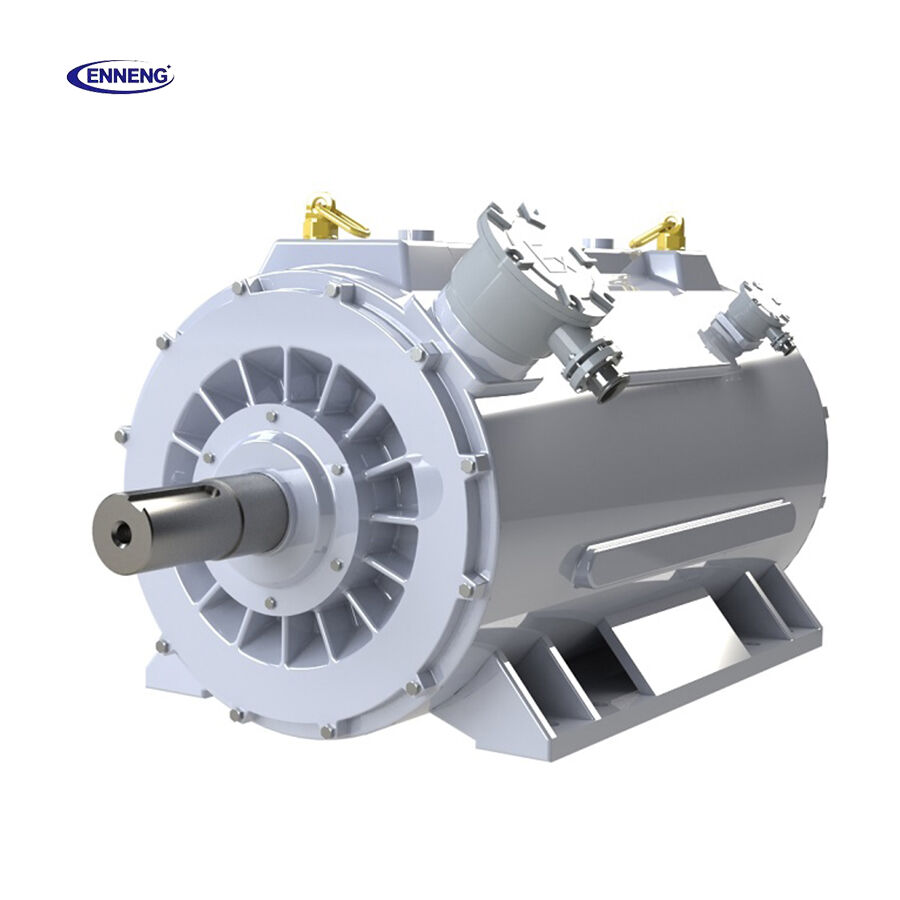
Supported by our elite R&D team consisting of engineers from the National Rare Earth Permanent Magnet Engineering Centre, and backed by dozens of patents, we customise high-voltage (6kV/10kV) and low-voltage (380V/660V/1140V) solutions to match your existing footprint. From water treatment facilities and oil wells to explosion-proof mining environments, we deliver optimal performance where general-purpose motors fail .
If you are evaluating commercial permanent magnet motors for sale and need an engineered drive solution that guarantees efficiency and longevity, ENNENG is your trusted partner.Contact ENNENG Today.Speak to our technical engineering team to receive a customised drive proposal.
- WhatsApp: +86 18562780228
- E-Mail: [email protected]
- Phone: +86 532 66000559

