
 EN

Water treatment plants are under pressure to deliver stable flow, meet discharge requirements, and control electricity use at the same time. That combination helps explain the growing attention around a Centrifugal Pump Motor IE5. The interest is not simply about choosing the highest label on a datasheet. It is about matching a motor, drive, pump curve, and process duty cycle so the whole pumping system performs sensibly over years of service.
As a technical sales consultant working with permanent-magnet motor applications, I would start with the operating profile rather than the nameplate. A water-treatment pump may run continuously, but it rarely operates at one steady hydraulic point. Influent variation, filtration cycles, backwash demand, tank levels, and seasonal loading can all move the duty point. A Centrifugal Pump Motor IE5 is therefore attracting attention because it can be considered as part of a variable-speed, system-level energy strategy rather than as an isolated replacement part.
The real problem: pumps consume energy away from their design point
Many existing pumping stations were designed around fixed-speed induction motors and mechanical throttling. That approach can be robust, but it can also force a pump to create more head or flow than the process needs and then dissipate the excess across a valve. The resulting electrical cost is visible month after month, while the source of the loss may remain hidden in the control philosophy.
A Centrifugal Pump Motor IE5 matters most where process demand changes and the control strategy can use speed as a lever. Under the conventional centrifugal-pump affinity relationships, flow changes roughly in proportion to speed, head changes with the square of speed, and power changes with the cube of speed. These are engineering planning relationships, not a substitute for a pump curve or commissioning test. Still, they show why modest speed reduction can change the energy picture so quickly.
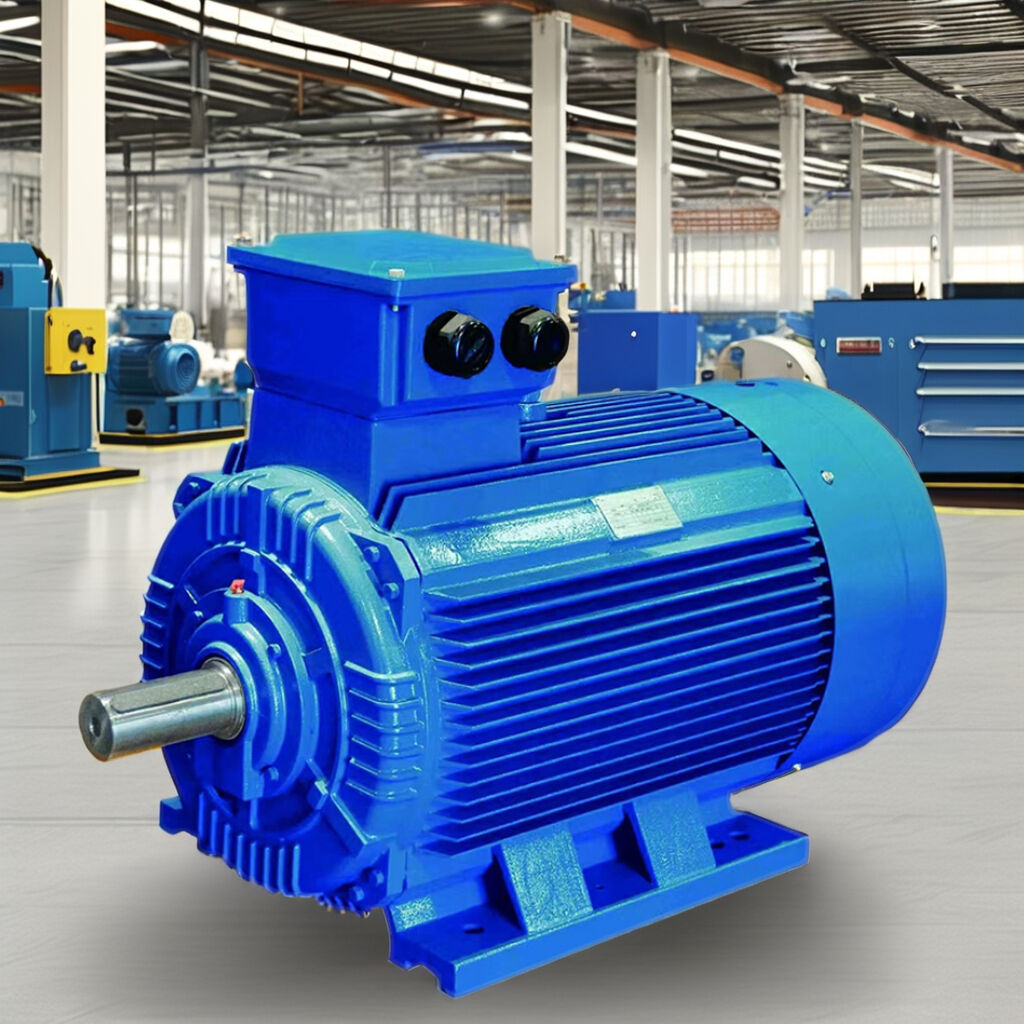
This is also where an IE4/IE5 Efficiency Motor discussion becomes more useful than a simple efficiency-class comparison. A motor’s actual contribution depends on its operating speed, torque demand, drive settings, ambient conditions, hydraulic behavior, and maintenance condition. A premium motor cannot correct an oversized impeller, a fouled strainer, or a poorly tuned level-control loop.
Why IE5 is drawing attention in water treatment
There are three practical reasons a Centrifugal Pump Motor IE5 is receiving closer evaluation. First, electricity is a recurring operating cost in pumping-intensive facilities. Second, water-treatment duty commonly includes partial-load periods, where motor-and-drive behavior can matter as much as the published rated-load figure. Third, operators increasingly need an upgrade path that supports both energy-management goals and reliable process control.
IE5 is generally discussed as an ultra-premium efficiency class, but engineers should distinguish the class designation from proof of performance in a specific installation. IEC also identifies IEC TS 60034-30-2:2016 as an efficiency classification for motors driven by converters. That context is relevant because a Centrifugal Pump Motor IE5 is often specified with a variable-frequency drive rather than on a direct-on-line, fixed-speed duty.
The shift is subtle but important. Instead of asking, “Which motor has the highest catalogue efficiency?” the better question is, “Which motor-and-drive combination maintains suitable efficiency, control stability, and thermal margin across our real flow profile?” That is why the strongest evaluations combine motor data with pump curves and measured site conditions.
Partial-load behavior changes the conversation
Water treatment loads are often variable by design. Lift stations respond to wet-well level, circulation pumps follow treatment stages, and distribution pumps react to demand. A Centrifugal Pump Motor IE5 can be attractive in these settings when its operating characteristics are assessed across the expected speed range. The point is not that every plant must replace every motor. Rather, variable-duty pumps can offer a clearer business case than constant-load equipment that already operates near a stable point.
There is a boundary to keep in mind: reducing speed does not automatically deliver the same savings predicted by a simplified calculation. System curve changes, static head, minimum-flow requirements, cavitation margin, and control constraints all affect the result. If a site has a large static-head component, for example, the affinity-law estimate needs careful interpretation. That is precisely why pump curves and field measurements belong in the selection process.
A Centrifugal Pump Motor IE5 should also be checked for thermal behavior at low speed, compatible VFD control parameters, and the required torque reserve during starts or transient events. These details may sound routine, but they separate a well-integrated upgrade from a motor swap that creates commissioning delays.
What engineers should verify before specifying an upgrade
Recognition for a Centrifugal Pump Motor IE5 grows when buyers can verify more than a marketing claim. A structured review should cover the following items:
- Duty profile: Record flow, head, speed, run hours, and loading over representative operating periods.
- Pump condition: Confirm the current pump curve, impeller condition, hydraulic losses, and any persistent throttling.
- Motor-and-drive compatibility: Review voltage, speed range, control mode, cable length, insulation system, bearings, and electromagnetic compatibility requirements.
- Environmental margin: Check enclosure, humidity, dust, ambient temperature, vibration, and corrosion exposure around the pump room.
- Evidence package: Request applicable efficiency documentation, dimensional drawings, speed-torque information, and operating limits rather than relying on a label alone.
This checklist protects against a common mistake: treating a Centrifugal Pump Motor IE5 as a universal answer. The right selection depends on the hydraulic system and the expected control regime. In a constant-speed, near-full-load duty, the return may differ from a variable-flow system that spends many hours below its design point.
Reliability and maintainability remain part of efficiency
Energy performance is only one part of water-treatment value. A pump that trips unexpectedly can disrupt process stability and create far larger costs than a marginal energy difference. For that reason, specification teams should review bearing arrangements, cooling method, sealing, alignment tolerance, VFD compatibility, monitoring options, and spare-parts planning alongside the Centrifugal Pump Motor IE5 efficiency data.
It is tempting to frame IE5 as a premium purchase decision. A better framing is lifecycle suitability. An efficient motor that is correctly matched to the duty, protected from its environment, and supported by clear technical documentation has a stronger chance of delivering its intended benefit. Conversely, a highly rated motor installed on a badly matched pump system can disappoint.
How to build a defensible water-treatment business case
To evaluate a Centrifugal Pump Motor IE5, establish a baseline before promising savings. Measure input power, speed, flow, head, run hours, and process constraints. Then model the candidate motor and VFD across realistic duty points, including minimum flow and peak demand. Follow with a commissioning plan that confirms rotation, control response, vibration, temperature, and process performance.
Be candid about assumptions. Savings projections should identify the baseline motor condition, the assumed operating profile, electricity price, and any pump-system modifications. This makes the calculation useful to operations, finance, and maintenance teams alike. It also prevents a generic efficiency claim from becoming a guarantee that no one can verify.

