
 EN

Why Centrifugal Pump Motor IE5 Improves Overall System Efficiency for Industrial Fluid Transportation Processes
In industrial fluid transportation, a pump train rarely wastes energy for just one reason. The pump may run away from its preferred efficiency region, flow may be throttled, the motor may spend long periods below rated load, and the drive may not be tuned to process demand. A Centrifugal Pump Motor IE5 can improve this picture, but not because an efficiency-class label magically fixes every hydraulic problem. Its value comes from reducing motor losses while supporting a better-matched pump, drive, and control strategy.
From an application-engineering viewpoint, the first question is not “Which motor has the highest nameplate efficiency?” It is “What does the actual duty cycle look like?” That distinction matters because many transfer, circulation, cooling-water, and treatment processes operate at changing flow rates rather than at one steady design point. A correctly selected Centrifugal Pump Motor IE5 can therefore be part of a system-level efficiency upgrade rather than an isolated component substitution.
Start with the complete pumping system, not the motor alone
A centrifugal pump converts shaft power into fluid flow and pressure; the motor converts electrical power into that shaft power. Losses occur in both stages, and in the VFD when speed control is used. Improving motor efficiency lowers the electrical input required for a given shaft output. Yet the largest practical gain may come when the Centrifugal Pump Motor IE5 also enables the pump to operate closer to the required duty instead of continuously overcoming an artificial restriction.
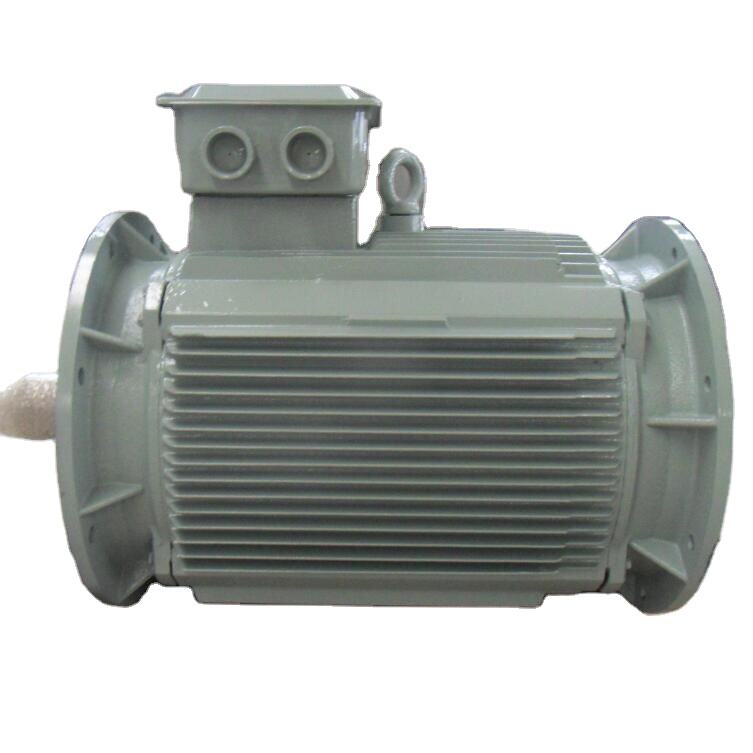
This is often misread as a motor-only issue, but it is really an operating-point issue. A system with an oversized pump and a throttling valve can still consume unnecessarily high energy with a premium motor. Conversely, a well-sized pump paired with a Centrifugal Pump Motor IE5 and appropriate speed control can reduce avoidable losses across the train. The purchase decision usually starts with unit price, but the number that matters over the equipment life is the electricity and maintenance burden created by the operating profile.
Where the IE5 advantage enters the energy balance
IE classes provide a useful way to compare motor efficiency, but they should be treated as a starting point. The input power to a motor equals the required shaft power divided by motor efficiency. When a Centrifugal Pump Motor IE5 reduces electrical losses at the required operating point, less input electricity is needed to produce the same shaft work. That reduction is repeated during every operating hour, which is why run hours and load profile are central to the business case.
An IE4/IE5 Efficiency Motor is especially worth evaluating where the pump runs for long hours, sees frequent load changes, or is part of a process with several parallel pumping trains. Still, the comparison must use the manufacturer’s applicable efficiency data, speed range, cooling arrangement, and drive configuration. IEC efficiency classes are commonly discussed at rated conditions; real installations should also examine behavior at the loads where the pump actually spends its time.
The shift that changes specification work is realizing that peak efficiency at rated load only matters if the process really reaches that load. If a circulating pump normally operates well below its design flow, selection based only on full-load catalog figures can miss the dominant annual energy condition. A Centrifugal Pump Motor IE5 should be assessed on its usable efficiency map, not simply on the largest number on a data sheet.
Why variable speed can multiply the system benefit
For many centrifugal-pump applications, flow, head, and absorbed power change with speed according to the affinity-law relationship. In friction-dominant systems, reducing speed to meet reduced demand can cut absorbed power much more effectively than dissipating excess pressure through a control valve. A Centrifugal Pump Motor IE5 does not replace a variable-frequency drive, but it can complement a properly matched VFD by reducing conversion losses on the motor side of a variable-speed system.
There is an important boundary: the result is not universal. Systems with significant static head do not respond like purely friction-dominant systems, and aggressive turndown can move a pump away from its preferred operating region. More precisely, lower speed is not automatically better; the correct speed is the one that meets the required flow and head while keeping the pump, motor, and drive within acceptable operating limits. That is why a Centrifugal Pump Motor IE5 should be selected with the pump curve and system curve in hand.
- Variable process demand: speed control may avoid continuous throttling losses.
- High annual operating hours: a modest reduction in motor loss has more time to accumulate.
- Part-load operation: verify the motor and drive efficiency where the equipment actually runs.
- Parallel pumps: coordinate staging and speed so each pump avoids prolonged inefficient operation.
Selection checks that protect real-world efficiency
Evaluating a Centrifugal Pump Motor IE5 in isolation without accounting for the pump curve, fluid properties, piping resistance, and control logic can produce a technically compliant specification that still underperforms in the field. A practical review should begin with measured or credible design data: minimum, normal, and maximum flow; required head; static-head fraction; fluid temperature and viscosity; ambient conditions; and annual duty distribution.
- Confirm hydraulic duty. Establish where the system curve intersects the pump curve at each meaningful demand condition.
- Check motor loading. Avoid selecting a motor so oversized that normal operation sits in an unfavorable portion of its efficiency range.
- Match the VFD and motor. Confirm voltage, current, insulation, cooling, cable length, switching considerations, and the permitted speed range.
- Check low-speed cooling and torque. A Centrifugal Pump Motor IE5 running slowly may require a cooling method and control settings appropriate to its construction.
- Commission with measurements. Record flow, pressure, kW, speed, vibration, and temperature before declaring an efficiency improvement.
Ambient temperature, altitude, contamination, and fluid-service conditions also matter. If the installation runs hotter than the motor’s reference conditions, derating and cooling should be reviewed before committing to a frame size. Likewise, cavitation, recirculation, or poor suction conditions can erase expected savings by damaging hydraulic performance and increasing maintenance demand.
Commissioning turns specification into measured improvement
A reliable way to validate a Centrifugal Pump Motor IE5 project is to compare like-for-like operating points rather than compare one month’s utility bill with another. Capture baseline electrical kW, flow, head, valve position, and operating hours for representative duties. After installation, verify that the control loop reaches the required process setpoint without excessive cycling or hunting. Then compare specific energy, such as kWh per unit volume moved, across equivalent production conditions.
This approach also reveals whether the opportunity lies in the motor, the pump, the controls, or all three. An IE4/IE5 Efficiency Motor can reduce losses, but a control sequence that constantly forces a pump against a nearly closed valve may remain the larger issue. The useful outcome is a documented operating envelope that maintenance and production teams can sustain.
Engineering Consultation and Coastal Project Inquiries
Engineering an effective Permanent Magnet Generator for shoreline industrial applications demands an accurate assessment of local salinity levels, ambient temperature variations, and continuous duty cycles. Integrating a robust marine-rated machine prevents expensive unscheduled outages, minimizes maintenance labor, and optimizes energy recovery across continuous port and shoreline processes. Collaborating with an experienced High Efficiency Motor Supplier guarantees proper enclosure customization, verified winding insulation protection, and complete engineering support. Contact technical specialists today to evaluate site parameters and specify customized coastal generation solutions.
- WhatsApp: +86 18562780228
- E-Mail: [email protected]
- Phone: +86 532 66000559
When an IE5 motor is the right upgrade
A Centrifugal Pump Motor IE5 is most compelling when it is part of a verified system design: a pump selected near the relevant duty points, a compatible drive where variable flow exists, and a commissioning plan that measures results. It may be less compelling for lightly used equipment, a fixed-duty process already operating efficiently, or a system whose principal loss is hydraulic rather than electrical. There is no universally applicable answer; the right choice depends on load profile, operating hours, electricity cost, control method, and the condition of the existing pump.
For industrial fluid transportation, the key lesson is simple: specify the Centrifugal Pump Motor IE5 as one element of an integrated energy strategy. Review the duty cycle, model the pump and system curves, validate VFD compatibility, and measure performance after start-up. That method turns an efficiency class from a catalog attribute into a repeatable way to lower energy use while protecting process reliability.

