
 EN

A conveyor jams for a moment, a pump sees a pressure spike, or a mixer meets a denser batch than expected. In each case, the driven equipment asks for more torque before the process can tolerate a noticeable speed drop. A PM Synchronous Motor can respond well to this kind of event, but the practical reason is more precise than “permanent magnets make it strong.” The response comes from the interaction of the rotor, the inverter, the control loop, the mechanical train, and the thermal duty cycle.
For plant engineers, that distinction matters. A correctly specified PM Synchronous Motor and drive can restore torque quickly and predictably; an undersized inverter, weak DC bus, poorly tuned controller, or unsuitable gearbox can still turn the same load surge into a trip. The useful question is therefore not whether a PM Synchronous Motor survives every overload. It is whether the complete drive system has enough transient torque, current margin, cooling recovery, and protection coordination for the real process.
Why a PM Synchronous Motor reacts quickly to a load step
In a PM Synchronous Motor, permanent magnets establish rotor flux without the rotor excitation current used by many other synchronous designs. With vector control, the variable-frequency drive regulates the torque-producing current component independently from the flux-related component. When the load rises, the drive can command more torque current almost immediately, provided it remains within the inverter and motor limits. That direct control is the core reason a PM Synchronous Motor can be effective in fast-changing industrial duties.
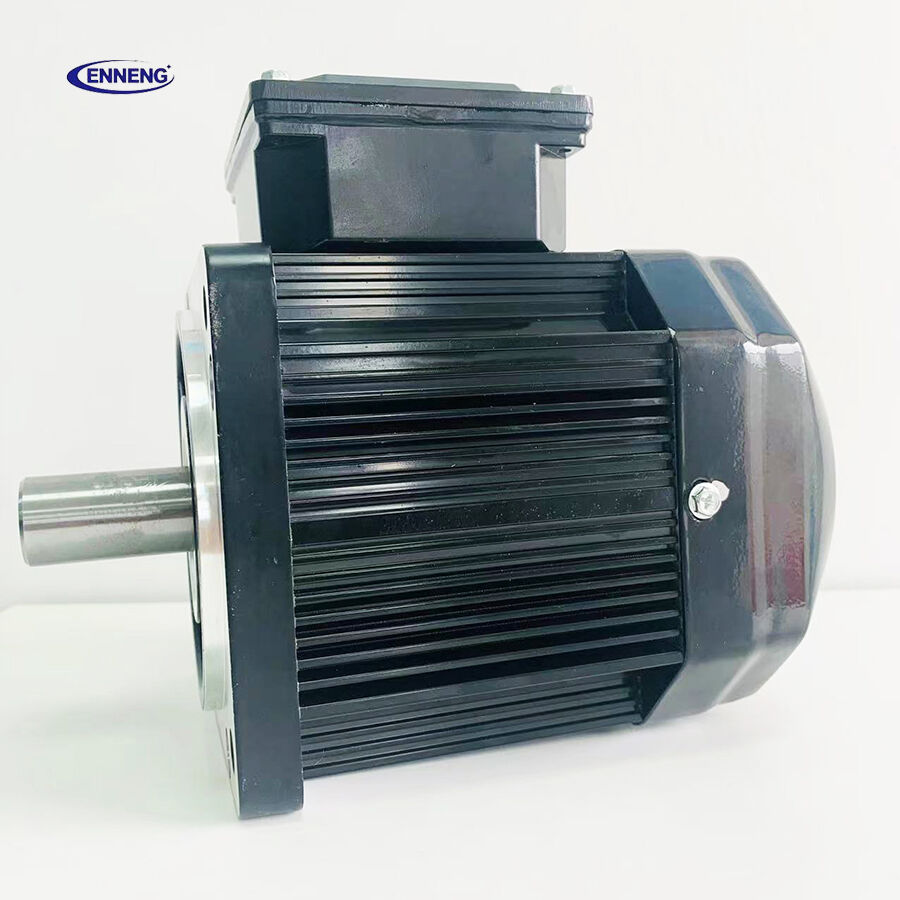
Rotor design helps as well. Many PM Synchronous Motor designs offer high torque density and a favorable torque-to-inertia relationship. Less rotating inertia does not create torque by itself, but it can make speed correction more responsive once electromagnetic torque is available. In a packaging line or a cyclic pump application, that can reduce the time spent below the intended speed after a disturbance.
There is an important correction here: rapid torque response is not the same as unlimited overload capacity. The PM Synchronous Motor must be paired with a drive whose peak-current rating, control bandwidth, DC-bus capacity, and protection settings fit the event. If any one of those constraints is reached first, the system will limit torque or trip even when the motor itself is capable of more.
What actually resists the sudden load surge
1. Closed-loop torque control
A modern PM Synchronous Motor drive uses current feedback and rotor-position information to calculate the torque command. During a sudden load increase, the controller detects a speed or torque error and raises current within its permitted range. Good tuning prevents the response from becoming slow, oscillatory, or overly aggressive. For a PM Synchronous Motor operating with repeated load changes, commissioning should check the response with the real machine—not only with an unloaded shaft.
2. Usable inverter current headroom
The inverter supplies the short-duration current that creates extra torque. A PM Synchronous Motor nameplate cannot substitute for the inverter’s overload curve. Ask whether the drive can provide the required current for the measured surge duration and repetition rate, and whether upstream supply impedance or a weak DC bus will reduce that margin. This check is especially relevant where several drives accelerate together or where regenerative events disturb the DC link.
3. Rotor position and speed stability
Because a PM Synchronous Motor runs synchronously with its commanded electrical field, accurate feedback and stable control are critical under a torque transient. If the controller loses reliable rotor position information or reaches its voltage limit at speed, torque production can deteriorate. Sensor selection, encoder wiring, field-weakening settings, and parameter identification are therefore part of surge-load robustness, not minor commissioning details.
4. Mechanical stiffness beyond the motor shaft
A PM Synchronous Motor may produce the requested torque while the coupling, belt, gearbox, or driven machine absorbs it poorly. Backlash, a flexible shaft, loose mounting, or resonance can turn a load step into vibration and repeated torque oscillation. In practice, vibration traced to mounting or transmission compliance is often mistaken for a motor limitation. Check the whole rotating system before changing motor size.
Repeated surges are a thermal-duty question
A single short event and a recurring production cycle are not equivalent. Copper loss rises with current, so repeated high-torque requests can accumulate heat even if a PM Synchronous Motor does not trip during one isolated test. IEC 60034-1 duty classifications reinforce the basic engineering principle: suitability is assessed against the actual duty cycle, not just a continuous nameplate point.
For a PM Synchronous Motor, document the surge magnitude, duration, events per hour, ambient temperature, speed during the event, and recovery time. Then verify winding temperature, inverter temperature, cooling airflow, and allowable bearing and gearbox loads. Enclosure and cooling matter too. A motor installed in a hot, enclosed cabinet area may have less thermal recovery than the same PM Synchronous Motor on a clean, ventilated test floor.
Where Permanent Magnet Motor PMSM selection can go wrong
A Permanent Magnet Motor PMSM is often chosen for efficiency and controllability, but a surge-duty specification should begin with the process load curve. Do not select only on rated kilowatts. A PM Synchronous Motor may be an excellent fit for a variable-speed pump, fan, extruder, mixer, hoist, or conveyor when the control system is designed for the transient demand. Yet the application may instead need a different gear ratio, a larger drive, a stronger mechanical transmission, or a revised acceleration profile.
Separate a process jam from a normal overload. A PM Synchronous Motor can be configured to supply controlled short-term torque, but protective limits should still remove energy safely when a jam persists. Treating protection as a nuisance to be bypassed is not a reliability strategy.
A practical specification checklist for a PM Synchronous Motor
- Measure the load-torque profile, including worst-case step changes and their frequency.
- Specify the PM Synchronous Motor and inverter as a package, including short-term current capability.
- Confirm torque availability at the actual operating speed, including any field-weakening range.
- Check coupling, gearbox, shaft, belt, and mounting stiffness for transient torque and vibration.
- Validate cooling and temperature rise against the real duty cycle and ambient conditions.
- Commission current limits, speed-loop tuning, stall protection, and fault recovery on the completed machine.
The ENNENG Customisation Advantage
No two industrial facilities share the same spatial or mechanical constraints. ENNENG stands out because we do not just supply off-the-shelf catalogue products; we specialise in delivering a tailor-made permanent magnet motor tailored to your specific application .
Supported by our elite R&D team consisting of engineers from the National Rare Earth Permanent Magnet Engineering Centre, and backed by dozens of patents, we customise high-voltage (6kV/10kV) and low-voltage (380V/660V/1140V) solutions to match your existing footprint. From water treatment facilities and oil wells to explosion-proof mining environments, we deliver optimal performance where general-purpose motors fail .
If you are evaluating commercial permanent magnet motors for sale and need an engineered drive solution that guarantees efficiency and longevity, ENNENG is your trusted partner.Contact ENNENG Today.Speak to our technical engineering team to receive a customised drive proposal.
- WhatsApp: +86 18562780228
- E-Mail: [email protected]
- Phone: +86 532 66000559
The bottom line
A PM Synchronous Motor can resist sudden load surges because field-oriented control can translate available inverter current into controlled electromagnetic torque quickly, while permanent-magnet rotor design supports compact, responsive drive systems. But the claim is conditional. A robust outcome is more likely when the PM Synchronous Motor, inverter, feedback device, mechanical train, and cooling design are evaluated against a measured industrial duty cycle. Specify that system together, and load surges become an engineering condition to manage rather than an unpredictable production interruption.

